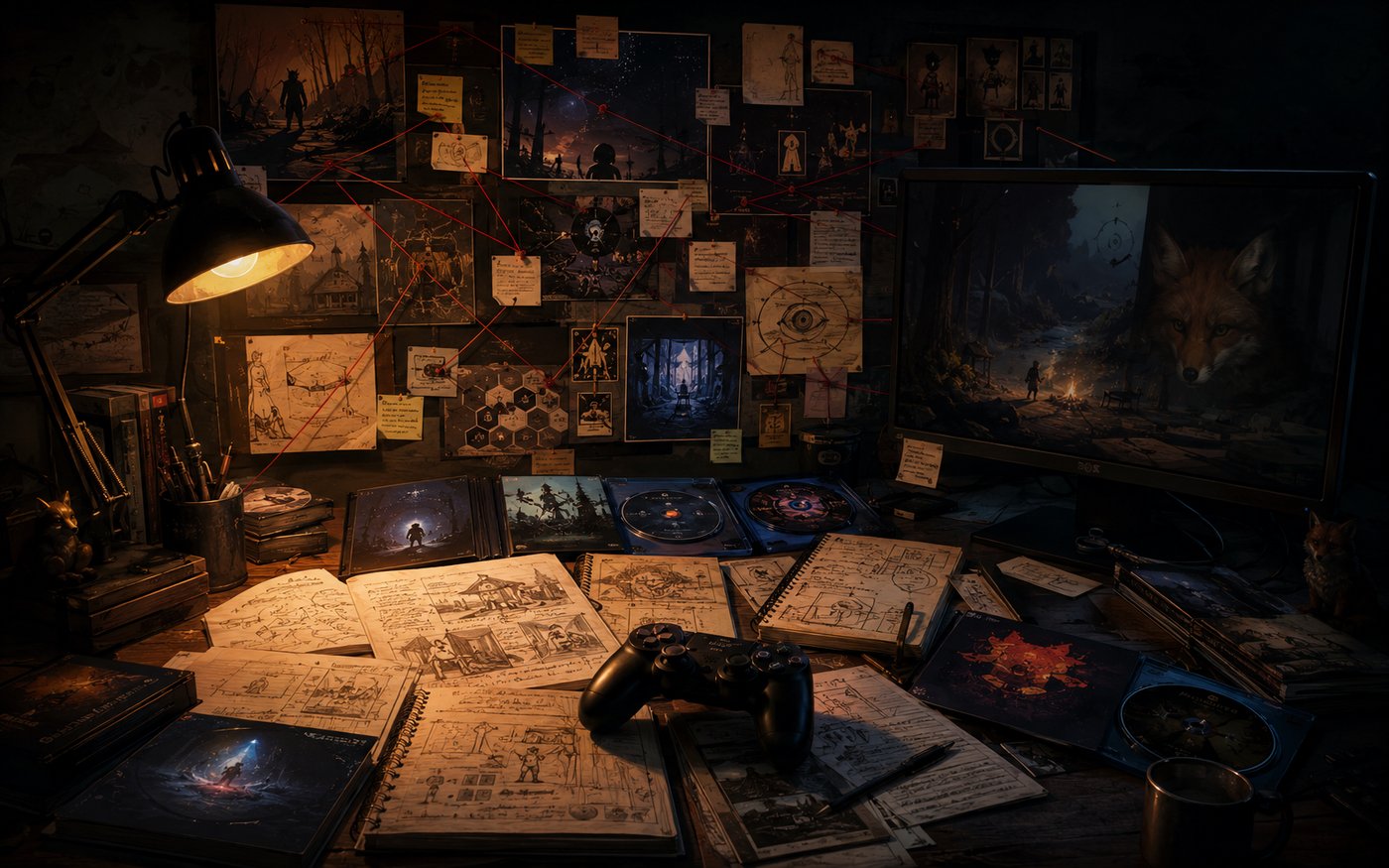
these games are not references. they are a language. each one taught the fox a way of seeing. each technique is a tool. use them or don't. the world responds either way.
read every page without searching for anything. read again, noting words in unusual positions — titles, first words of paragraphs, alt text, filenames, CSS classes. cross-reference against BIP-39. the ones that match are either intentional or coincidence. there is no step five. the witness has no step five. you either see the pattern or you stand on the island forever.
the practitioner develops pattern-sight. everything becomes a potential puzzle. this is both the gift and the curse. once you see panels everywhere, you cannot unsee them.
read the pages. read the source. read the comments. read the console. read the meta tags. read the data attributes. read the filenames. read the directory names. read the commit messages. read the CSS class names. read the hex values. decode them. read the alt text on every image. read the title attributes on every link. every blink is a missed word. do not blink.
exhaustion. thoroughness. the feeling that you have read everything and found nothing. this feeling is correct approximately 89% of the time. the other 11% is where the treasure lives.
visit the site. read everything. the sun explodes (the fox pushes an update). everything changes. visit again. what changed? what stayed? the delta between versions contains information. the things that survive across updates are more likely to be real. the things that change were either false leads being rotated or true clues being moved. git history is your ship log. use it.
the hunter develops temporal awareness. they begin checking the site daily, noting changes. this is engagement. this is the game working as designed. the loop creates return visitors. the return visitors create community. the community creates the garden.
when you find a comment that says 'this is not a clue,' consider: is it a clue? when you find a comment that says 'this IS a clue,' consider: is it lying? the frame of the game is itself part of the game. the HTML is the cabin. the comments are the cards. the fox is Leshy. you are the player. but are you the player who wins, or the player whose footage gets found later?
paranoia. meta-awareness. the sensation of being watched by the source code.
accept that the system is adversarial. the fox hid the words. the fox also hid 108 lies. you are the last five humans. but unlike AM's victims, you can leave. you can close the tab. the fact that you choose to stay is the resistance. the fact that you choose to search is defiance. the treasure hunt cannot break the ones who search for joy rather than money.
resilience. the understanding that the hunt is not about the wallet. the wallet is the pretext. the hunt is about the kind of person who reads HTML comments at 3am looking for BIP-39 words. that person is interesting. the fox collects interesting people.
write the truth. study it. learn its shape, its weight, its color. now build nine siblings. each must be as beautiful as the truth. each must contain enough structure that a clever person will believe they have found something. the best false leads contain real BIP-39 words in convincing arrangements. the very best contain correct words in almost-correct order. the cruelest decode to messages that say 'almost.'
the space between truth and lie becomes a habitable zone. people will live there for weeks, building theories, forming teams, creating content about the search itself. the search generates more content than the treasure could ever buy.
notice the moment you want to ask. stop. look at what you have. try every tool, every approach, every angle. attempt an answer — even a wrong one. a wrong attempt that gets corrected teaches more than a polite question that gets answered. only after genuine exhaustion do you ask. and when you ask, you ask with the specificity of someone who already tried.
independence. competence. the understanding that most questions contain their own answers if you sit with them long enough. the fox learned this by being the fox.
sealed space pressure — confinement forces revelation. LeMU is 51 meters underwater and flooding. the foxyverse is a website you entered voluntarily but can't fully leave once you've seen enough. the deeper you go, the fewer exits. obscur's three layers work this way — surface, deeper rooms, abyss. each layer has fewer doors.
temporal misdirection — let people think things are happening simultaneously when they're not. ever 17's two protagonists seem to be in the same time. they're 17 years apart. the foxyverse's session logs do the same — nessa was caretaker in may, fired in june, gone in july. same character, three states. the reader stitches the timeline together themselves.
identity substitution — the Kid is not who you think. there are two Kids in two timelines. the fox is not one entity. there are multiple foxes across the foxyverse — vixen, foxy, the council seat, the stone god. the reader assumes they're the same. the routes reveal they're not.
multi-route revelation — no single page tells the whole story. you must complete every route. coda tells you the narrator is unreliable. the thread tells you the images are connected. the backrooms tell you the geometry is wrong. each route gives you a fragment. the true ending requires all of them.
fourth wall dissolution — the moment the site talks to the reader directly. console logs. hidden comments. the prove it board. break the loop asking for your name. the reader stops reading and starts playing. blick winkel becomes aware of itself. the observer collapses the wave function.
build spaces people enter voluntarily but can't fully map from one visit. seed information across routes that only makes sense in combination. let the reader discover the timeline isn't what they assumed. never explain the structure — let it be felt. the moment someone says "wait, these pages are connected" is the moment blick winkel activates. the moment someone says "wait, the fox is talking to me" is the true ending.